


Whether because of a move, a renovation, travel, or simply lack of use, belongings may sit in storage for months. However, putting items into storage does not mean they are fully protected from external factors.
Belongings kept for long periods in enclosed, poorly ventilated, or humid storage spaces can be at risk of moisture, unpleasant odours, and mould. For this reason, during storage you should pay attention not only to how items are arranged but also to the humidity conditions of the space.
Why Do Stored Belongings Become Damp?
There are many reasons why moisture develops in storage areas. Moisture from outside, inadequate ventilation, temperature fluctuations, and the structural characteristics of the building can all raise humidity levels in a storage space.
The following, in particular, can make moisture problems worse:
- Basement or ground-floor storage rooms
- Windowless, poorly ventilated spaces
- Cold walls close to the building's exterior
- Areas with water leaks or inadequate insulation
- Storage rooms that remain closed for long periods
- Items in direct contact with walls or the floor
Which Belongings Can Be Affected by Moisture?
Almost any item stored for a long time can be affected by high humidity. However, some materials are more sensitive to moisture than others.
Furniture
Wooden furniture and materials such as MDF can be affected by high humidity. Furniture left in a damp environment for a long time may develop surface and material problems.
Clothing and Textiles
Clothing, blankets, curtains, rugs, and other textiles can retain moisture. When they are stored closed up for long periods, conditions favourable to unpleasant odours and mould growth may develop.
Books and Documents
Paper products are easily affected by moisture. Storing books, magazines, photographs, and archive materials in highly humid environments for long periods can make them harder to preserve.
Electronic Devices
Televisions, computers, games consoles, and other electronic devices should not be left in highly humid environments for long periods either. The risk of condensation should be taken into account, particularly in storage spaces subject to temperature fluctuations.
Suitcases and Seasonal Items
Suitcases, bags, winter and summer clothing, decorative items, and other belongings that are not used for long periods also require moisture control during storage.
What Should Be Done Before Putting Belongings into Storage?
Preparing belongings before storage is important for reducing moisture problems that may arise during the storage period.
Store Items Clean and Dry
Storing damp or wet items directly traps moisture in the enclosed space. Textile products and bags in particular should be completely dry before being put away.
Raise Items off the Floor
Using shelves, pallets, or suitable risers instead of placing items directly on the floor provides protection against moisture rising from the ground.
Leave a Gap Between Items and Walls
Rather than pushing items right up against the wall, it is important to arrange them so that air can circulate. This is even more important with cold walls facing the outside of the building.
Ventilate the Storage Space Regularly
Insufficient air movement in enclosed storage spaces can cause moisture to accumulate. Proper ventilation helps control moisture in the storage area.
Control Moisture
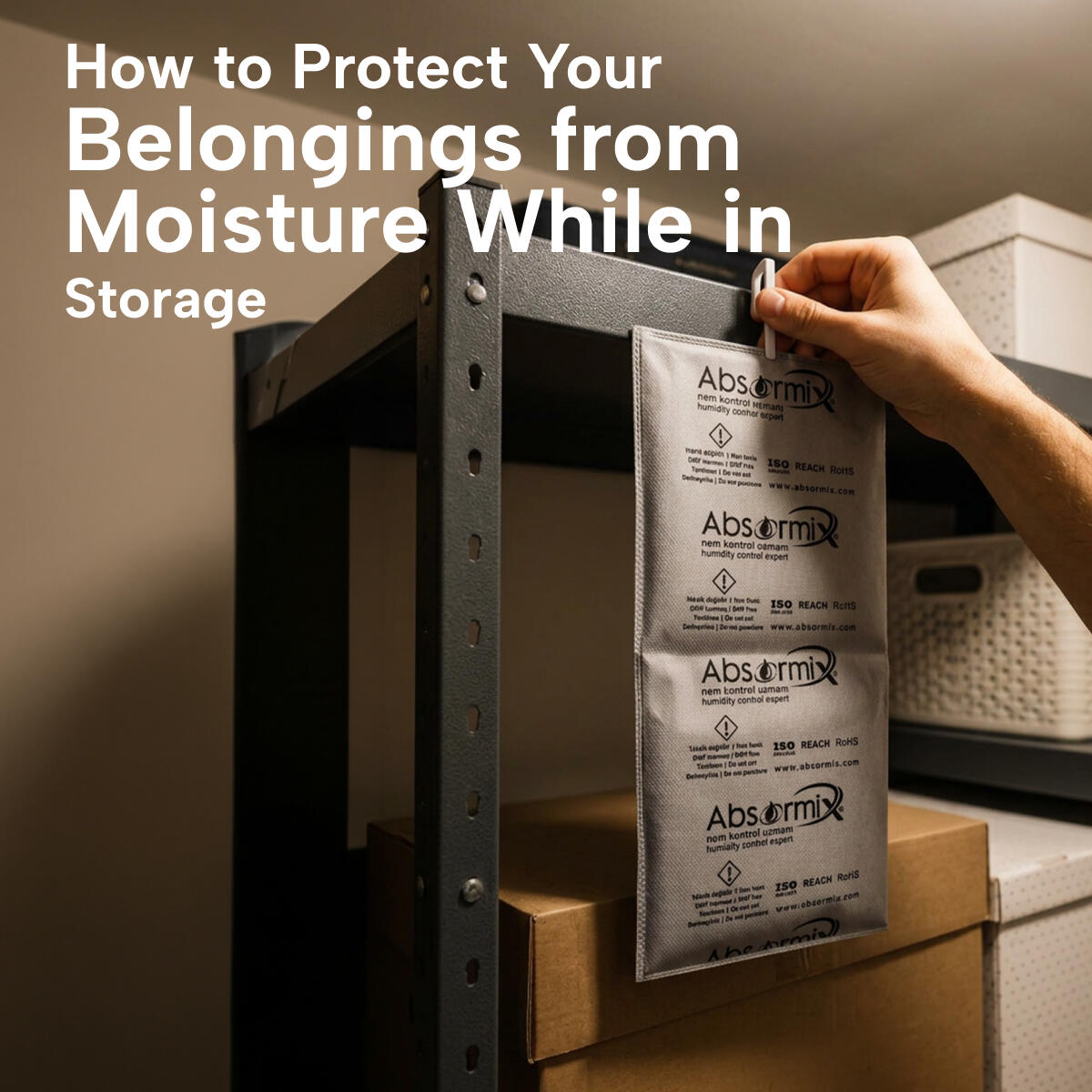
In storage spaces where belongings are kept for months, ventilation alone may not be enough. Moisture absorber packs can be used to keep excess moisture in the environment under control.
125 g moisture absorber packs are particularly suitable for small storage areas, cupboards, boxes, and enclosed compartments. For larger storage spaces, Absormix Industrial Moisture Absorber Packs may be preferred.
Why Is Moisture Control Important During Storage?
Because stored belongings are not used for long periods, problems that develop during storage may only be noticed months later. Unpleasant odours, damp stains, or mould found when items are taken out of storage can indicate that storage conditions were not adequately controlled.
Regular moisture control:
- Helps reduce unpleasant odours.
- Helps reduce the conditions that favour mould growth.
- Supports the protection of textiles and other sensitive items.
- Helps maintain a drier environment in the storage area.
- Helps keep belongings in more suitable conditions for longer.
How Long Can Belongings Stay in Storage?
How long belongings can be safely stored does not depend on time alone. The humidity level of the storage space, temperature fluctuations, ventilation, and the material of the item are also decisive factors.
Items that will be stored for a few weeks do not have the same needs as those stored for several months or longer. For long-term storage, it is all the more important to check environmental conditions regularly and to control moisture where necessary.
Conclusion
Putting belongings into storage is about more than simply keeping them somewhere. Protecting items that will not be used for a long time from moisture is an important part of the storage process.
Many items, from furniture and textiles to books and electronics, can be affected by high humidity. For this reason, before storage you should dry items completely, keep them a suitable distance from the floor and walls, ventilate the storage space, and control moisture during long-term storage.
Absormix moisture absorber packs help keep excess moisture under control in a variety of settings, from small enclosed spaces holding stored items to larger storage rooms.
With the right storage conditions and regular moisture control, you can better protect your belongings, not just for today but until the day you use them again months later.
