


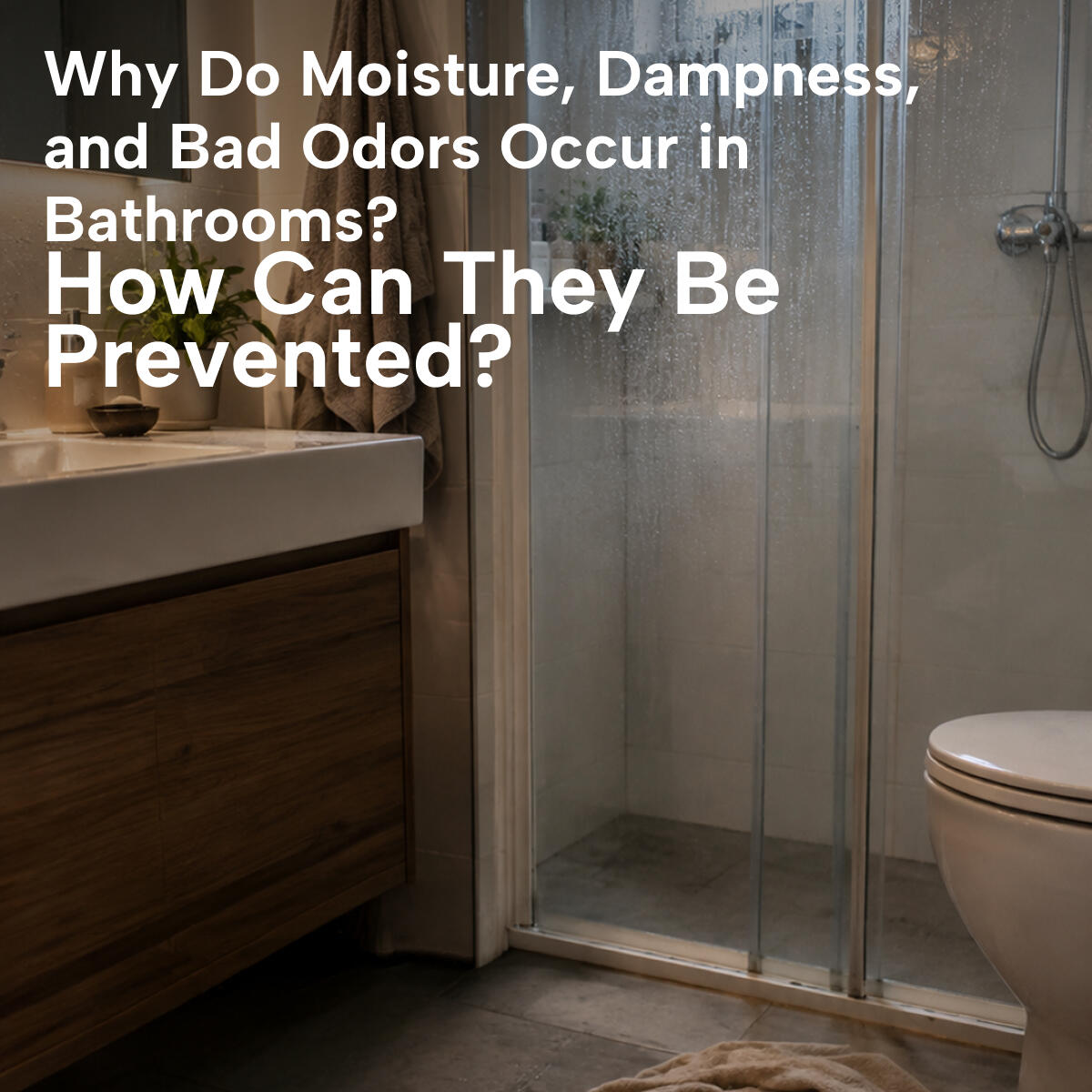
The bathroom is one of the areas of the home where humidity rises most easily. Steam from showering, wet towels and surfaces, inadequate ventilation, and temperature changes can all lead to excess moisture in the bathroom.
If moisture is not kept under control for long periods, problems such as musty odours, unpleasant smells, condensation, and mould growth can develop.
So why do moisture and damp build up in the bathroom? How can bathroom odours be prevented? And what can be done to reduce mould growth?
Why Does Moisture Build Up in the Bathroom?
The main source of moisture in the bathroom is showering and hot water. When hot water is used, a large amount of water vapour is released into the air. If this humid air remains in the bathroom after a shower, humidity levels continue to rise.
In addition, the following can increase the amount of moisture in the bathroom:
- Wet surfaces after showering
- Wet towels and bathrobes
- Inadequate ventilation
- Windowless bathrooms
- Drying laundry in the bathroom
- Condensation on cold walls and surfaces
Where air circulation is poor in particular, the excess moisture produced after a shower can remain in the bathroom for a long time.
Why Does Damp Develop in the Bathroom?
Damp is generally associated with high humidity persisting over long periods.
If the humid air produced after a shower is not adequately removed, condensation can form on bathroom surfaces. Over time, repeated exposure to humid conditions can lead to signs of damp appearing on walls, ceilings, grout lines, and corners.
For this reason, bathroom damp may not be solved simply by cleaning the stains on the surface. The excess moisture at the root of the damp also needs to be controlled.
Why Does Mould Develop in the Bathroom?
Mould can develop more easily in damp, poorly ventilated environments.
In the bathroom, mould stains are most often seen:
- Around the shower enclosure
- On tiles and in grout lines
- In ceiling corners
- Where walls meet
- Around the washbasin
- In areas with inadequate ventilation
Persistently high humidity in the bathroom can contribute to conditions that favour mould growth.
For this reason, one of the most important steps in reducing mould growth in the bathroom is controlling excess moisture.
What Causes Unpleasant and Musty Odours in the Bathroom?
Moisture is not always the only cause of unpleasant odours in the bathroom. Drains, traps, insufficient cleaning, ventilation problems, or plumbing issues can also cause odours.
However, a musty odour can be linked to prolonged high humidity in the environment.
Particularly in bathrooms that are kept closed and not adequately ventilated, humid air and wet surfaces can cause unpleasant odours to linger for longer.
For this reason, when you notice an unpleasant odour in the bathroom, it is important to identify the source of the odour rather than simply masking it.
What Should the Humidity Level Be in a Bathroom?
For indoor environments, a relative humidity of 40–60% is generally considered a balanced range.
It is normal for bathroom humidity to rise briefly while showering. However, if humidity stays high for a long time after a shower, it can increase the risk of moisture-related problems such as condensation, damp, and mould.
For this reason, the aim is not to eliminate moisture in the bathroom completely, but to bring the excess moisture produced after a shower under control as quickly as possible.
How Can Moisture and Damp Be Prevented in the Bathroom?
Several measures should be combined to reduce moisture and damp in the bathroom.
1. Ventilate the Bathroom Regularly
Opening a window or running the extractor fan after showering helps remove humid air.
2. Dry Wet Surfaces After Showering
Removing water left on the shower enclosure, tiles, and other surfaces helps reduce moisture build-up.
3. Do Not Leave Wet Towels in the Bathroom
Wet towels and bathrobes can release extra moisture into the bathroom. Wherever possible, they should be dried in a well-ventilated area.
4. Check Mould-Prone Areas Regularly
Grout lines, ceiling corners, and the area around the shower enclosure should be checked regularly. If mould keeps coming back, the source of the moisture should be investigated rather than just cleaning the surface.
5. Keep Excess Moisture Under Control
In small, enclosed bathrooms where ventilation is insufficient, moisture absorbers can also be used.
Can Moisture Absorber Packs Be Used in the Bathroom?
Yes, moisture absorber packs can be used in the bathroom.
Particularly in small, enclosed spaces with limited air circulation, moisture absorber packs help keep excess moisture in the air under control.
Absormix moisture absorber packs absorb excess moisture from the air and retain it inside the pack in gel form.
In this way, they help control excess moisture in the bathroom, reduce the damp environment, and keep the conditions that contribute to damp and unpleasant odours under control.
However, moisture absorber packs are not a substitute for ventilation or plumbing repairs. If there is a water leak, a plumbing problem, or a serious source of damp in the bathroom, this should be addressed first.
Why Is It Important to Control Bathroom Moisture?
Controlling moisture in the bathroom is important not only for reducing mould growth but also for maintaining overall comfort when using the bathroom.
Keeping excess moisture under control helps:
- Reduce damp
- Prevent conditions that favour mould growth
- Reduce humid, heavy air
- Control musty odours
- Reduce condensation on walls and surfaces
Conclusion
Moisture in the bathroom is unavoidable, especially after showering. However, when excess moisture remains in the bathroom for long periods, it can increase the risk of problems such as damp, mould, condensation, and unpleasant odours.
For this reason, it is important to ventilate the bathroom regularly, dry wet surfaces, remove wet textiles, and fix any water leaks.
In addition, Absormix moisture absorber packs help keep excess moisture in the air under control, particularly in small, enclosed bathrooms.
Remember: the aim in the bathroom is not to eliminate moisture completely, but to keep excess moisture under control and create an environment that helps reduce damp, mould, and unpleasant odours.
