


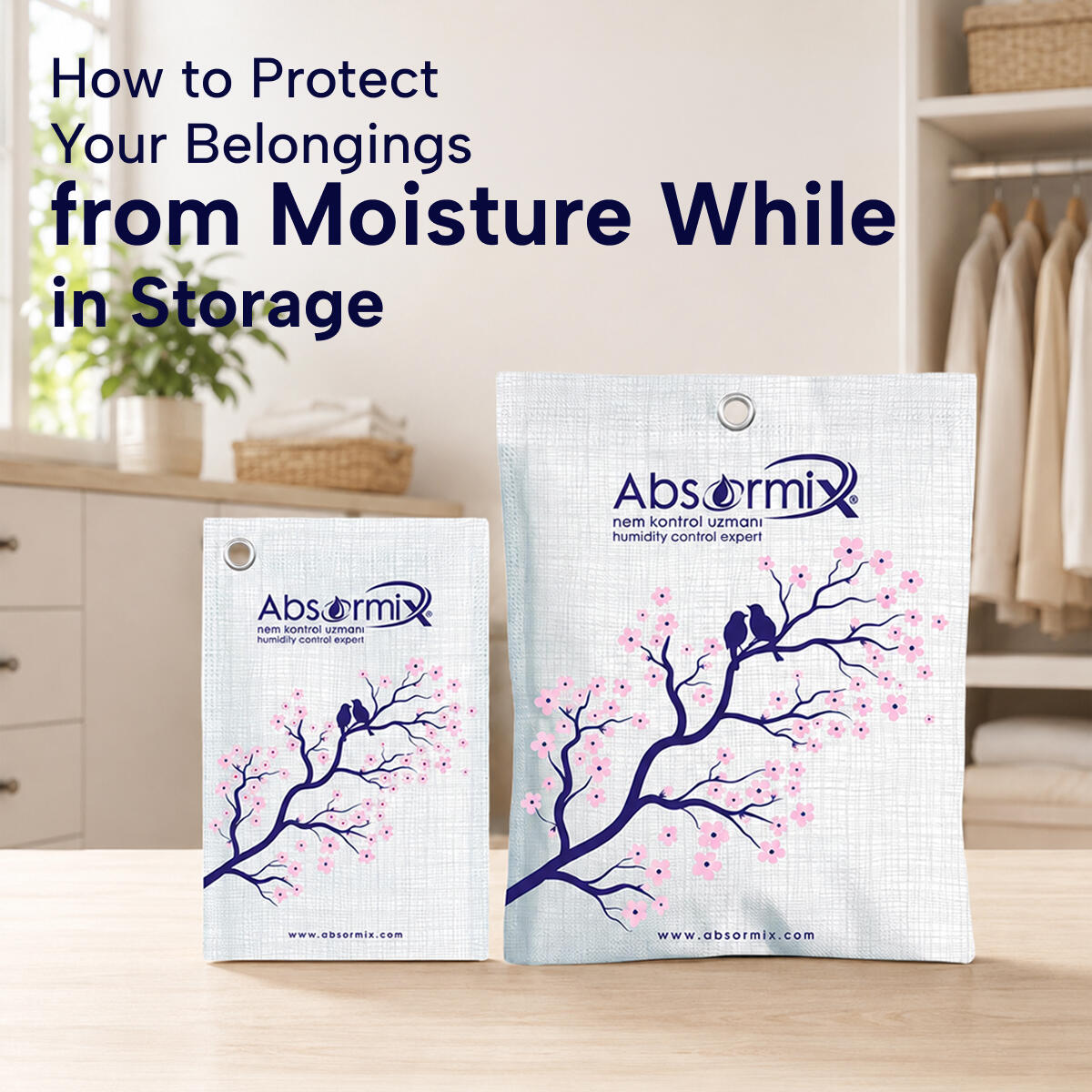
We cannot see the moisture in the air with our own eyes. However, when humidity rises, we notice it through problems such as damp air, condensation, unpleasant odours, or mould that may develop over time.
So how much humidity is considered normal in a room? Where does excess moisture in the air go, and how do moisture absorber packs control it?
To answer these questions, we first need to look at what relative humidity means.
What Is the Ideal Humidity Level?
For indoor environments, a relative humidity of between 40% and 60% is generally considered a balanced range.
For example:
- 30% and below: The environment may be quite dry.
- 40–60%: Generally a balanced and comfortable humidity range.
- Above 60%: Humidity levels in the environment begin to rise.
- 70% and above: If sustained for long periods, conditions become more favourable for moisture-related problems.
What matters here is not just a sudden rise in humidity, but how long high humidity persists.
For example, it can be perfectly normal for humidity in a room to rise briefly to 70% after a shower. However, if humidity in a storage room remains at 70–80% for days, this means prolonged high humidity and increases the risk of moisture-related problems.
For this reason, the aim of moisture control is not to remove all moisture from the environment, but to keep excess moisture under control.
What Does “Excess Moisture” Mean?
Relative humidity is the ratio that shows how much water vapour the air contains compared with the maximum amount it can hold at a given temperature.
For example, when the relative humidity of a room is 50%, the air contains roughly half the water vapour it can hold at the current temperature.
When humidity rises to 70–80%, the amount of water vapour in the air increases. Particularly in areas subject to temperature fluctuations, this can create more favourable conditions for problems such as condensation.
This is where controlling excess moisture becomes important.
The purpose of moisture absorber packs is not to draw all the moisture out of the air, but to absorb the excess moisture in the environment and help keep humidity levels under control.
Where Does the Excess Moisture in the Air Go?
In fact, excess moisture does not simply disappear.
A moisture absorber pack absorbs excess moisture from the air and retains it inside the pack.
Absormix moisture absorber packs use a blend of calcium chloride (CaCl₂) and starch. Calcium chloride is the active ingredient that strongly absorbs moisture from the air.
When a moisture absorber pack is placed in a space, the process works quite simply:
Excess moisture in the air → absorption → retention inside the pack → gel formation
As moisture is absorbed, the product's structure changes and, over time, it takes on a gel-like consistency.
So when the pack turns into gel, it does not mean the product is not working. On the contrary, it shows that it has been absorbing moisture from the environment.
How Do Moisture Absorber Packs Work?
The working principle of moisture absorber packs can be explained in four basic stages.
1. Moisture in the Air Reaches the Pack
Water vapour in an enclosed space is constantly moving. The moisture absorber pack comes into contact with the moisture in the surrounding air.
2. Excess Moisture Is Absorbed
The calcium chloride inside the pack absorbs excess moisture from the air.
The aim here is not to draw all the moisture out of the air. It is to help control humidity that has risen above the level the environment needs.
3. The Absorbed Moisture Is Retained Inside the Pack
The absorbed moisture is held within the product's structure. Instead of remaining in the surrounding air, the moisture accumulates inside the pack.
4. Gel Is Formed
As more moisture is absorbed, the product's structure turns into a gel-like consistency.
Absormix's formulation containing calcium chloride and starch ensures that the absorbed moisture is retained in gel form.
Do Moisture Absorber Packs Remove All the Moisture from the Air?
No.
The purpose of moisture absorber packs is not to eliminate all moisture from the environment.
For example, the goal is not to make a room with 50% humidity completely dry. The aim is to help prevent humidity from staying at high levels for long periods and to help keep excess moisture under control.
For this reason, moisture absorber packs are not a substitute for ventilation or for fixing a structural moisture problem. In areas with water leaks, insulation problems, or a constant source of water, these problems should be addressed first.
Moisture absorber packs, on the other hand, are a practical solution that supports the control of excess moisture in the environment.
Why Do Moisture Absorber Packs Form Gel?
One of the key features of how Absormix works is that the absorbed moisture is retained in gel form.
While calcium chloride absorbs moisture from the air, starch helps hold the absorbed moisture in a gel structure.
As moisture is absorbed, the product's structure changes and gel is formed.
This system ensures that the absorbed moisture is retained inside the pack.
Where Can Moisture Absorber Packs Be Used?
Moisture absorber packs can be used to control excess moisture, particularly in enclosed spaces.
For example:
- Wardrobes and dressing rooms
- Shoe cabinets
- Pantries and kitchen cupboards
- Drawers
- Car interiors
- Caravans
- Boats and yachts
- Suitcases and travel bags
- Areas where camping equipment is stored
- Electronic equipment bags
- Small storage areas
- Archive and document cabinets
For larger spaces, industrial moisture absorber packs can be used.
What Does It Mean When a Moisture Absorber Pack Is Full?
When a moisture absorber pack reaches a gel-like consistency over time, this shows that the product has absorbed moisture from the environment.
How long a pack lasts depends on the conditions of the environment. In areas with high humidity, the product will absorb more moisture, so it may last for a shorter time.
Depending on environmental conditions, Absormix moisture absorber packs can remain effective for approximately 45–60 days.
Why Should Excess Moisture Be Controlled?
In environments where humidity stays high for long periods:
- Unpleasant odours may develop.
- Condensation may occur.
- Conditions favourable to mould growth may arise.
- Textiles and fabrics may be affected by moisture.
- Some stored products may become harder to protect.
- Enclosed spaces may feel damp.
For this reason, it is important to assess conditions and provide the necessary moisture control, particularly when humidity levels remain above 60% for long periods.
Conclusion
For indoor environments, a relative humidity range of 40–60% is generally considered balanced. A brief rise in humidity is not always a problem. However, when humidity remains above 60% for long periods, it indicates excess moisture in the environment and can create more favourable conditions for moisture-related problems.
The purpose of moisture absorber packs is not to eliminate all the moisture in the air. It is to absorb excess moisture and help keep humidity levels under control.
Absormix's formulation containing calcium chloride and starch absorbs excess moisture from the air and ensures that the absorbed moisture is retained inside the pack in gel form.
In short:
40–60% → balanced humidity
Above 60% → high humidity that needs to be controlled if it persists
Moisture absorber pack → absorbs excess moisture → forms gel → retains moisture inside the pack
Thanks to this working principle, moisture absorber packs offer a practical solution for keeping excess moisture under control and reducing moisture-related problems, particularly in enclosed spaces.
